A luxury bespoke jewelry atelier: a WooCommerce store turned into a custom-ring design studio, run end-to-end from GoHighLevel
A family-owned US bespoke fine-jewelry house whose highest-value work is engagement rings commissioned one at a time. Every sale is a commission, not a purchase — a $200 design deposit up front, a CAD design to approve, and the real production cost quoted and collected later.
Bespoke engagement rings, commissioned one at a time
A family-owned American fine-jewelry house selling bridal rings, wedding bands, loose diamonds and fine jewelry — with ready-to-ship pieces from around $1,200 to $3,200+, shipping to 28+ countries with multi-currency checkout. Their highest-value work, though, isn't anything on the shelf: it's bespoke engagement rings, at prices well above the ready-to-ship range.
A customer describes the ring they want, the studio produces a CAD design, the customer approves it (or asks for revisions), and only then does the ring go into production. A single order can run for months and pass through a dozen hands.
None of this is e-commerce as WooCommerce understands it
There is no product to add to a cart — there's a specification. The customer doesn't pay a price — they pay a $200 CAD design deposit up front, and the real production cost is quoted and collected later. And the studio doesn't run the job in WordPress at all: they run it on a Kanban board in GoHighLevel, their CRM. The brief was three problems stacked on top of each other:

Almost everything here is custom — none of it exists off the shelf
A configurator that captures a real specification, a ten-stage lifecycle, a two-way CRM sync, a customer portal, and three sales channels converging on one checkout.
The ring configurator — a jeweler's intake form that becomes an order
We replaced the product page with a guided configurator that asks what a jeweler would ask. The customer picks one of two paths — specify it in detail, or upload inspiration photos and let the studio design it — and the form adapts: stone provenance, diamond or gemstone, lab-grown or natural, shape, carat, colour and clarity, metals, ring size, band width, prong and shank style, engraving, and free-form notes. Whatever they build, the cart line becomes one thing the business can take money for: a flat $200 CAD design deposit, with every answer landing permanently on the order.
A ten-stage production lifecycle the business runs on rails
A commission isn't 'processing' then 'completed.' We modelled the studio's real process as first-class order states — design requested, CAD uploaded, CAD approved, deposit paid, in production, ring complete, awaiting balance, shipping pending, shipped, delivered — and gave each commission its own record holding the CAD file, the turntable video, the diamond certificate, the production price, what's been paid, what's owed, and the tracking number.
Two-way CRM sync — the studio drags a card, the storefront moves
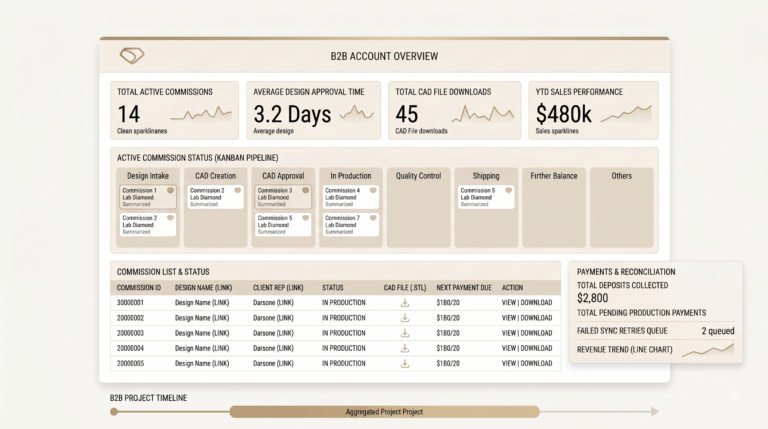
Outbound, the moment a deposit is paid, the platform creates the CRM contact, opens an opportunity in the production pipeline, maps every ring specification onto a dedicated CRM field, attaches a written summary, and pushes the financials. Inbound, a webhook fires whenever anyone moves a card — and the platform reads live field values straight back out of the CRM by field ID, so a customer's diamond certificate never depends on unreliable merge tags. Every call in both directions is logged, and failed syncs are queued and retried automatically.
The customer's design portal — see it, approve it, revise it, pay for it
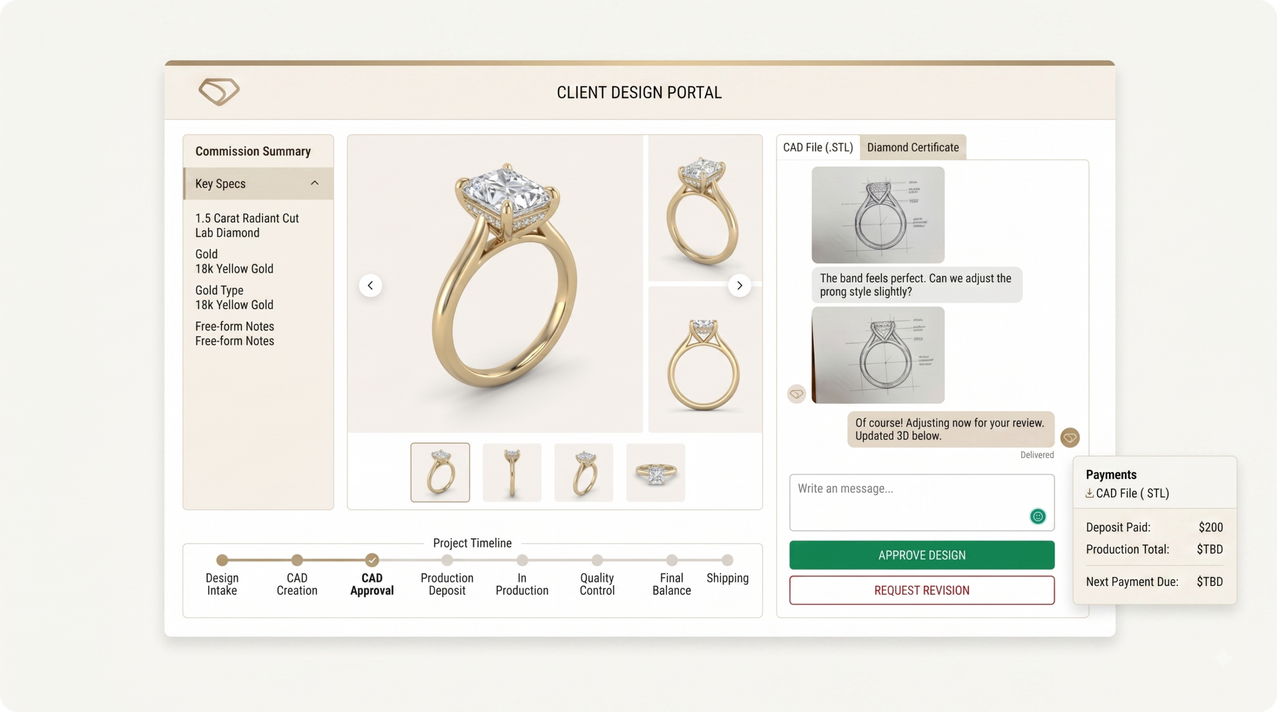
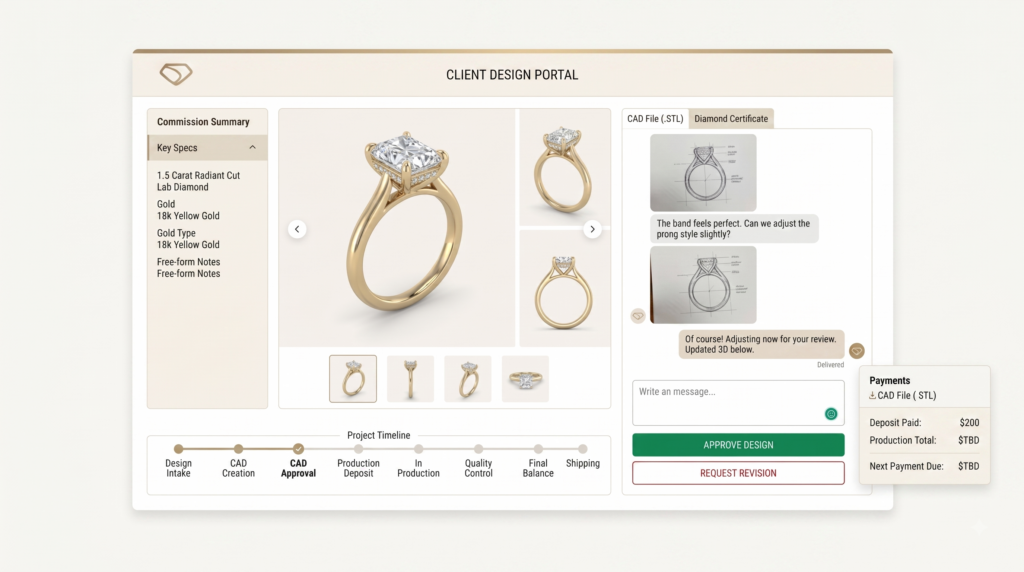
Customers get a private portal for their commission: a visual timeline, the CAD design, the turntable video and the diamond certificate as soon as the studio uploads them, and a single decision — approve the design, or request a revision. They can message the studio in a threaded, real-time conversation, and pay their production deposit or final balance without leaving the page.
Production payments — deposit, balance, rush and engraving
Once a design is approved and the studio sets the production price, the customer pays the rest — half now and the balance later, or in full — as linked payment orders against the parent commission. Optional extras — a 25% rush fee, a flat laser-engraving fee — fold into the maths automatically, and the deposit already paid is credited against the final total.
Phone sales & $0 consultations — reps sell, customers still pay for themselves
Reps get a private, unlisted page that clones the configurator — but they only collect details; nothing is charged and no card is touched. The customer gets a branded link, sets a password, finds their ring already in their own cart, and completes the exact same checkout every self-serve customer uses. A single checkbox turns a call into a $0 consultation: the customer still confirms and places the order, they just don't pay — and that flag follows the money all the way down so the books still add up.
Sales attribution — every phone order traceable to the rep who made it
The rep's code travels the whole way — from the form, into the customer's cart, onto the order, into the commission record, and finally into a dedicated CRM field of its own, not buried in a note. That distinction was the point: the team needed to filter the pipeline by rep, which you can't do on note text.
The back office — dashboards, an API black box, and one-command provisioning
Staff get a commissions dashboard with inline status changes and live unread-message badges, plus an API log viewer: every inbound and outbound CRM call, filterable, with full payloads — so when the CRM misbehaves, the answer is one screen away. One CLI command provisions every required CRM field and maps the pipeline stages by ID. And underneath, the plugin is a real application — service container, models, versioned migrations, namespace-isolated dependencies — tested end-to-end against the live CRM through a Cloudflare Tunnel before anything ships.
A look at what shipped
The customer portal and the commission pipeline behind it.
What we built it with
The major platforms behind this project — chosen to fit the customer's existing stack, and handed over in full at the end.


Representative of this engagement. We pick tools to fit your stack and your people, not the other way round.
Where it stands
Customer anonymized at their request. Capability summary — ask us for current figures on this engagement.
Selling something that must be designed before it can be priced?
Bespoke, made-to-order, commissioned, quoted — a normal store doesn't fit you, and you already know it. The order is a specification, the price arrives later, and the people doing the work live in a CRM, not in WordPress. We've built exactly that, in production.
And if your people already live in GoHighLevel: we made it the operating system of a real e-commerce business — pipeline stages that drive the storefront, not just report on it, in both directions, reliably.
If that's what you're trying to build, you're one conversation from a head start.